
AI & Closed-Loop Control
Developing data-driven and predictive algorithms for real-time control of therapeutic ultrasound.
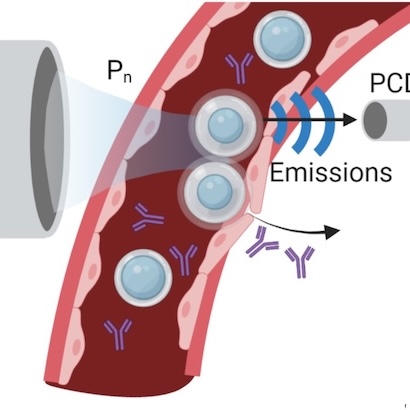
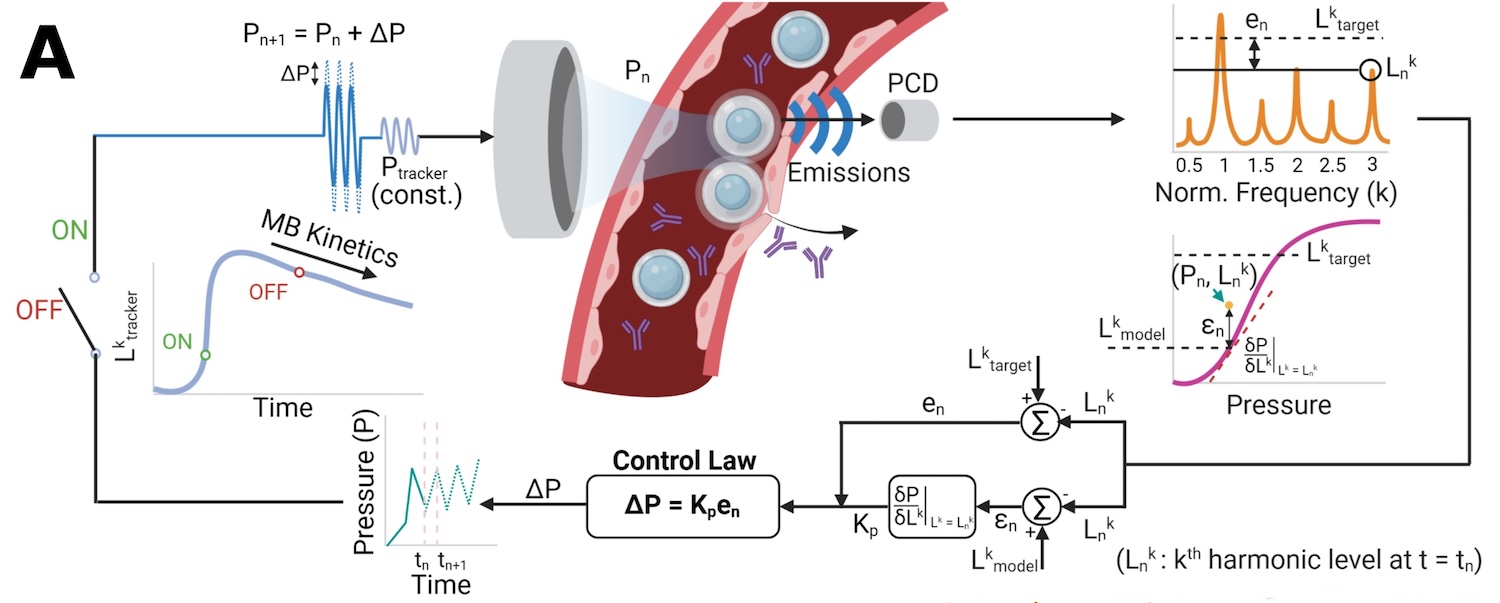
Complementing our real-time monitoring platforms, our laboratory develops algorithms to precisely regulate microbubble (MB) dynamics in vivo. Because MB oscillations can become unstable and collapse, causing tissue damage, their control is critical to safety and efficacy. We developed an in vivo closed-loop controller that adapts ultrasound exposure to MB activity in the mouse brain while suppressing MB collapse. We demonstrated that this controller enhances immune-checkpoint inhibitor delivery, leading to extended survival in a glioblastoma model (Science Advances 2022).
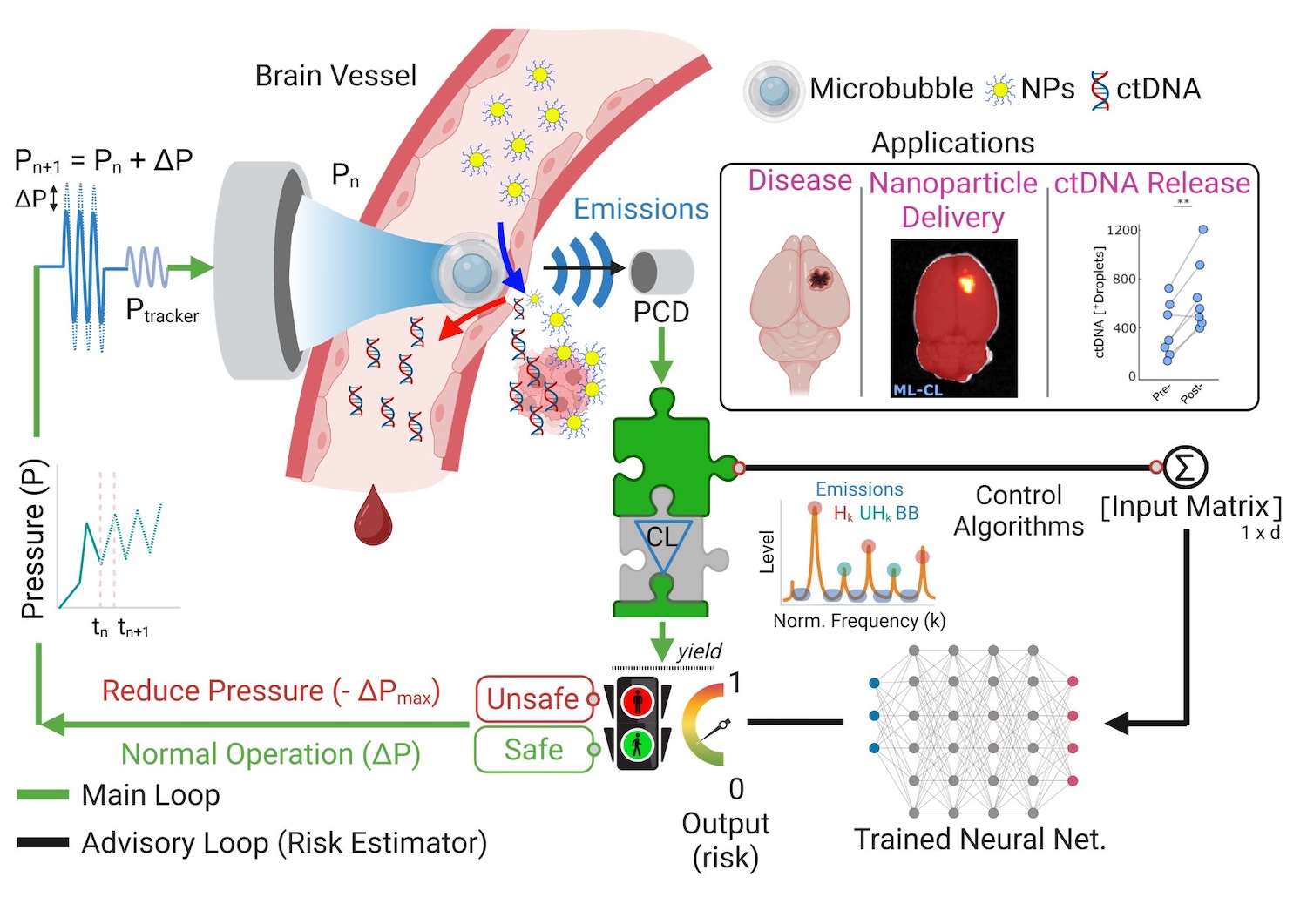
Despite these advances, the nonlinear and stochastic nature of MB dynamics makes their precise control in vivo challenging. To address this limitation, we pioneered a machine-learning-based predictive control system for guiding trans-skull MB-FUS (Advanced Science, 2026). Rather than reacting to MB collapse after its onset, our approach identifies acoustic signatures that predict impending instability and adapts sonication proactively. Trained on more than 54,000 acoustic-emission datasets and validated across species and disease models, it reduced broadband cavitation events by 90%, expanded the therapeutic window fourfold, doubled blood–brain barrier (BBB) permeability at equivalent safety levels, and increased nanoparticle delivery to tumors by up to sevenfold. The system also enabled the safe release of tumor-derived cell-free DNA into the bloodstream for liquid biopsy and revealed disease-specific differences in microbubble stability.
Paired with our physics-based, frequency-domain acoustic backpropagation framework (Results in Engineering 2026), these advances provide the foundation for physics-informed predictive control, integrating mechanistic wave models with data-driven predictions to anticipate and optimize therapeutic responses in real time.